Description
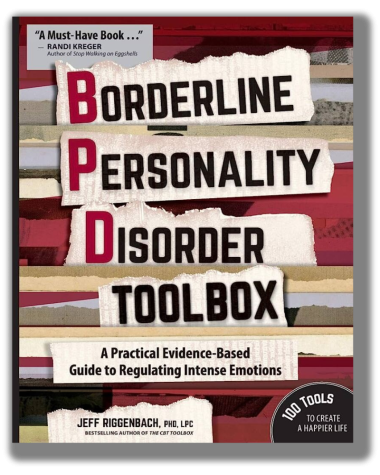
CONGRATULATIONS TO JEFF RIGGENBACH AND BORDERLINE PERSONALITY DISORDER TOOLBOX ON FINISHING AS A SILVER FINALIST IN BOTH PSYCHOLOGY AND SELF-HELP AT THE 2017 IBPA BENJAMIN FRANKLIN AWARDS!
-Do you feel misunderstood?
-Do mood swings hit you quickly and intensely?
-Are you susceptible to getting your “buttons pushed” more often than others?
-Can you love your partner with all your heart and passionate intensity one moment, and hate them just as much only an hour later?
-Do you constantly have a nagging voice in the back of your mind telling you someone you care about is going to leave you, and that you will never be able to make it in life without them?
If the answer to the majority of these questions is “yes,” it is likely that you have borderline personality disorder, or BPD.
But there is hope. And good news — BPD is a highly treatable disorder.
Drawing from a variety of evidence-based approaches, the Borderline Personality Disorder Toolbox is a real-world self-help workbook. Escaping generalizations and stereotypes, this complete guide is filled with practical explanations, along with over 100 worksheets and activities to improve behavior. Highlights include:
-Empower yourself so others can’t push your buttons
-Tips to cope with intense feelings
-Retrain your brain to constructively deal with distorted thoughts
-Take control of your emotions before they take control of you
-Tools to create a happier, healthier and more productive life!
Elizabeth (verified owner) –
Dr. Riggenbach’s “Borderline Personality Disorder Toolbox” presents beneficial information for anyone affected by BPD. I especially appreciate the inclusion of information for professionals. Oftentimes, expert authors only present information from a provider’s perspective, ignoring our perspectives, and the information is often laced with bias–intentional or not. For BPD individuals, the stigma is unavoidable & painful. Having received inadequate and inappropriate medical treatment due to my BPD diagnosis, I am grateful to see it tactfully addressed by Dr. Riggenbach. He addresses BPD so that patients, friends, families, and both medical and mental health providers can benefit from reading it as well as utilizing and practicing the skills, “tools”, and exercises provided. I have already been able to use several of the “tools” and exercises and found them very helpful. As a result, I confidently encourage anyone affected by BPD to buy Dr. Riggenbach’s book.
John L (verified owner) –
This book contains invaluable tools for clinicians and for our clients. Many mental health professionals are daunted by working with BPD clients and struggle to provide effective and caring therapy, as well as dealing with their own stress reactions. This book, which is so well organized and so clearly written, will help mental health professionals, such as myself, enormously in our work with this group of clients, who suffer so greatly and who so often receive inferior, non-evidence-based and compassion- devoid treatment. Jeff Riggenbach has done a masterful job in showing how Dialectical Behavior Therapy (DBT), Schema Focussed Therapy and more standard Cognitive Behavior Therapy can be applied skillfully to the many issues Borderline Personality Disorder clients can struggle with . The forms and handouts are also excellent; clear and well-written. The many case examples are very helpful and illustrative of both the way these clients experience the world and also of a way forward for many BPD sufferers. This book is unreservedly recommended..
John Ludgate, Ph.D.
CBT Center,
Asheville, NC
Julie Ann Dawson (verified owner) –
Borderline Personality Disorder Toolbox: A Practical Evidence-Based Guide to Regulating Intense Emotions by Jeff Riggenbach is a well-designed, practical workbook for those that suffer from BPD. Written in an accessible, conversational tone, Riggenbach presents the material in an easy-to-digest manner.
The workbook opens with a solid explanation of what BPD is, how it is defined, how to find a qualified therapist, and how to set treatment expectations. These opening sections empower the patient to take control of his or her treatment.
The workbook exercises are clear, concise, simple to follow, and cover a wide range of potential trigger situations. Though designed for the patient’s use, this book is a valuable resource for friends and family who want to better understand the condition so that they can provide needed support. Family can work through many of the worksheets with the patient to provide additional encouragement and reinforce the lessons.
Reviewer note: I received a comp copy of this book for review and criticism
J’Wanna S. (verified owner) –
Awesome purchase. This is a great resource for psychoeducation and challenging patients with BPD. I love the worksheets and explanations throughout this toolbox. It has helped several of my patients since I purchased and used the information. Now, they are planning to purchased this book and use it to help their families understand BPD. Again, a great buy.
Amber (verified owner) –
Good workbook. Educational.
Janine Baker (verified owner) –
Great book very happy but didn’t get it in two days.
Siany (verified owner) –
Really good red. Easy to follow.
Stormy feathers (verified owner) –
I was severely sexually and physically abused as a child and went through a few decades of therapy before being diagnosed with BPD. This book is very practical, checked it out of the library first, and then decided to use it as a workbook and take it to therapy to help facilitate more helpful dialogue than I’ve had in the past. I found it very helpful, I understand my limitations and I can look and work through certain aspects of this book if specific behavior crops up during stressful times. Also found that doctors responded better when I filled out the pages and then copied them and gave them to the therapist at the beginning of the session. I have had only 3 stable 30 year relationships, and this book helps when I need to look at myself from a loved ones perspective and then consciously modify my behavior. Also, I was able to realize that Bi-polar meds were my worst enemy and I should ramp it back and only use only one anti-depressant or one anti-anxiety (to sleep when overly stressed), and not get hooked into big time meds like Haldol, lithium, etc, which don’t help me and actually make things much worse. Good luck to sufferers and family members…its a long hard road.
Ouzola Customer (verified owner) –
Excellent book. Pratical and full of tips whether you are a therapist, sufferer or related to the sufferer.
Aleeza H (verified owner) –
I like having this book on hand, gives you info, insights, and perspectives. When my BPD becomes overwhelming, I refer back to this book and do a few pages on a separate piece of paper.
MrsHotRod (verified owner) –
Very informative book teaches true life practices
Jenny Jennerton (verified owner) –
As a counselor just entering the field, I found that this book was extremely helpful when working with those with BPD. The use of DBT plays a big part in working with those struggling with its symptoms. The writer is quite passionate in helping others and educating counseling professionals, it is an empowerment for both the client and the individual providing therapy. Great Job Jeff!!
Dawna (verified owner) –
The most helpful resource if its kind!
Penny Britton (verified owner) –
Great new helpful info
Ouzola Customer (verified owner) –
Good read helpful
Leonilla (verified owner) –
Just as described.
Marlène Laberge (verified owner) –
Tout est parfait pour ce livre.
John P. Sperstad (verified owner) –
Helps me through my issues
Charlene (verified owner) –
I started reading this book because I believe a loved one of mine my have BPD. I have also struggled with intense emotions in my lifetime, and, as an elementary school classroom teacher, I have students who have dealt with trauma or have other conditions of diagnoses that cause them to have difficulty regulating their emotions. I quickly read the informational section of the book. I love how it looks at BPD by describing the various ways in which it may manifest in different people. I also like how evidence is used to provide additional resources, as well as to support conclusions drawn in the book. It is done so in a way that is not at all distracting. It also lists a few different types of therapies that may be effective for BPD, as well as some things to avoid when looking for a good fit therapist.
There are also very helpful tips for people who have loved ones with BPD. I like how the book seems to be non-judgemental or offensive. It seems that it could help both those with BPD, their loved ones, therapists, and even the average person who would like to better control their emotions in a healthy way and improve relationships.
I have started to work on the skills myself, and I have found it extremely beneficial! I will continue to use these skills for myself, and feel confident that I will be able to apply what I learn to help support my future students’ emotional needs. Excellent book!
Design Star (verified owner) –
Very helpful information
Marcy Short (verified owner) –
Nice book for DIY work or in addition to DBT.
Ouzola Customer (verified owner) –
Incredibly helpful book!
EconMan (verified owner) –
I perhaps have never read a book more practically wrong and with so much carelessness for the love-ones of so called BPD people. All BPD means, is psychologists have no idea why someone is being so irrationally horrible and incredibly selfish. And it is far from treatable. In fact, I suspect any treatment has a higher probability of failing than succeeding.
There are “bad people” in the world, and although this “positive-psychology” movement is popular with some psychologists, there is little rational data showing BPD people can be treated at all. Sometimes there is no cure for just being a hateful jerk, abandoning children after years of abusing them, and treating everyone around them as if the exist for the BPD.
The best treatment if you’re in a relationship with such evil is a lawyer. Get them away from your kids, get them away from your finances, and get them away from you. Any virtue you possess and display will be used against you.
My understanding is “Who’s Afraid of Virginia Wolf” (Liz Taylor character) was written around BPD? Regardless, she had no real “cure” available to her, and neither do the people you love. Give the BPD what they really need — to be left alone. If they threaten to kill themselves, let them. Don’t visit them in the hospital (rarely do they *actually* kill themselves. go see a lawyer. This ongoing nightmare too is playing against your own virtues. If you too were a jerk and didn’t care about them, they would have no power. They take limitless advantage of ANYONE who begins to care about them. You see a hurt person in need; they see a emotional meal.
Don A. (verified owner) –
Another book highly recommended to me to help understand BPD that I found completely useless. This book has all kinds of “work sheets” that you are to fill out, but very little sustenance to help someone suffering from BPD to deal with and overcome the disorder let alone regulate intense emotions. Very disappointing.
Sherri Soule (verified owner) –
I like it because it explains a lot and at the same time it’s easy to understand
Kevin (verified owner) –
Just as described! Thank you!
Lpwolfe6 (verified owner) –
Very good and doable practices
ckllp (verified owner) –
I have been a DBT therapist for years and have lots of handouts and worksheets. This book was a great addition and not just a repeat of other stuff reformatted. It is presented as self-help but is very useful in therapy.
Kathleen Nelson (verified owner) –
Easy to use and understand book.
Ouzola Customer (verified owner) –
Great therapeutic tool for mental health professionals
Shoegal694 (verified owner) –
I found this book dry and not helpful in understanding. I have BPD and did not find this book relatable.
debsmada (verified owner) –
I was recently diagnosed with BPD and was feeling at a loss as to where to go from my diagnosis. This workbook, I feel, does more for me than does my therapy because it delves deep into me and my individuality and what’s going on with me personally. It’s actually fun to fill in the blanks as well and to have to really think.