Description
A NATIONAL BESTSELLER
“My Grandmother’s Hands will change the direction of the movement for racial justice.”— Robin DiAngelo, New York Times bestselling author of White Fragility
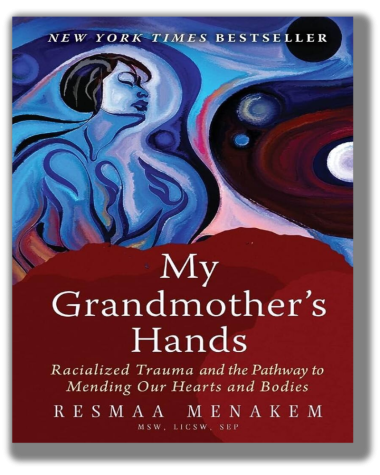
In this groundbreaking book, therapist Resmaa Menakem examines the damage caused by racism in America from the perspective of trauma and body-centered psychology.
The body is where our instincts reside and where we fight, flee, or freeze, and it endures the trauma inflicted by the ills that plague society. Menakem argues this destruction will continue until Americans learn to heal the generational anguish of white supremacy, which is deeply embedded in all our bodies. Our collective agony doesn’t just affect African Americans. White Americans suffer their own secondary trauma as well. So do blue Americans—our police.
My Grandmother’s Hands is a call to action for all of us to recognize that racism is not only about the head, but about the body, and introduces an alternative view of what we can do to grow beyond our entrenched racialized divide.
- Paves the way for a new, body-centered understanding of white supremacy—how it is literally in our blood and our nervous system.
- Offers a step-by-step healing process based on the latest neuroscience and somatic healing methods, in addition to incisive social commentary.
Resmaa Menakem, MSW, LICSW, is a therapist with decades of experience currently in private practice in Minneapolis, MN, specializing in trauma, body-centered psychotherapy, and violence prevention. He has appeared on the Oprah Winfrey Show and Dr. Phil as an expert on conflict and violence. Menakem has studied with bestselling authors Dr. David Schnarch (Passionate Marriage) and Dr. Bessel van der Kolk (The Body Keeps the Score). He also trained at Peter Levine’s Somatic Experiencing Trauma Institute.
V.E. (verified owner) –
My Grandmother’s Hands: Racialized Trauma and the Pathway to Mending Our Hearts and Bodies
by Resmaa Menakem is a new look and a new approach to healing from what has become known as “white supremacy”. This book proposes a wholly new approach to healing the divide in our society, where racism is rampant, black young men are routinely gunned down by police, and hurt prevails. A groundbreaking book that endeavors to heal generational racism, that which actually becomes inherited from one generation to another, and becomes a trauma that affects all of us. This revolutionary approach is new, and tries to forge a path to healing and peace. Research and experience combine here along with therapeutic expertise to instill a new paradigm for society as a whole. This is an intimate look at racial healing, beginning in the first chapter as the author notices his Grandmother’s hands, those that weathered picking cotton from a young age. Highly recommend for a new look at an age old problem that has become one of epic proportions in today’s world
Syd Seattle (verified owner) –
As a psychologist who works primarily with individuals in marginalized communities, I see a lot of clients who have experienced historical, intergenerational, developmental and ongoing current trauma, often as a result of systems of oppression (racism, sexism, homophobia, transphobia, etc.). I was very excited to dive into training in somatic experiencing (SE), a “bottom up” approach to trauma treatment that recognizes the ways that traumatic experiences get stored in the body, and therefore need to be healed through the body.
However, I was disappointed to find that most of the books on SE, as well as the trainings themselves, rarely if ever mention racism or other systems of oppression and the trauma they cause. This was such a disappointment to me, especially given that racial trauma is so prevalent in the everyday lives of my clients and perpetuated daily by the current political climate.
Therefore I was thrilled to discover this book. Resmaa Menakem filled in the gap I was feeling in the SE literature, applying somatic experiencing to racial trauma and the ways that racism impacts the bodies of white people, black people (and all people of color), and those who are charged with “serving and protecting” us, the police. This book was a huge eye opener for me. Not only did it give me compassion for my own white body and the ways that trauma has been metabolized and passed on from white folks to POC through the mechanisms of white supremacy, but it gave me new and more embodied ways to understand the lives of people of color and work effectively with my POC clients. It also gave me new compassion for cops, who, through their own trauma responses and the effects of white supremacy, are now more like soldiers whose mission is to control and suppress black and brown bodies. Although I will continue to feel outrage and grief at every unnecessary police killing of an innocent man or woman of color, this book helped me to remember that we are all impacted by centuries of white supremacy conditioning and that cops need and deserve healing around racial trauma too.
I highly recommend this book to therapists and healers, especially those who work with individuals in marginalized communities. Each chapter provides exercises to embody the learning in the chapter, so that healing is happening not just from the top down, but from the bottom up. There are exercises for individuals and groups, for white bodies, POC bodies and police bodies. The book is extremely timely and relevant and should be required reading for anyone wanting to understand more about the history and current conditions of racism in America, its impacts, and how to heal.
Gavin Cooley (verified owner) –
Resmaa Menakem’s, in My Grandmother’s Hands, with humility, delivers a beautifully written story, a page turner that I couldn’t put down, that is at first disguised as an easily accessible book on trauma but is actually no less than a clear step-by-step process for ending racism, class prejudice, oppression and violence in all its forms.
“Trauma-informed” is everywhere now – and thank god that is the case. Van Der Kolk’s Body Keeps the Score got the physiological processes of trauma out there in a big way. His recommendation however was for people who have experienced trauma, some combination of medication, therapy and yoga could heal them. Van Der Kolk falls short though in that he is focusing on people who have experienced trauma with a capital T, like rape, or war, or car accident – these people know that they have experienced trauma, which is only the tip of the iceburg. His #metoo-ing not with standing, I’d say read it, or at least listen to his interviews. Then read My Grandmother’s Hands. You’ll need some understanding of how the mind and body are a single entity to join Menakem, as he brings his lucky readers to the epistemological root of the trauma problem. That we are all carrying inherited cultural trauma and if we don’t begin to heal ourselves, we will just continue to blow it through each other, through our kids, through our grandkids, white, black, rich and poor. And blow it we do.
You’ve probably also got to get yourself out of your head with all of this. If you don’t understand what I mean by that or when I say that Descartes got it wrong, you may want to stop reading. However, Menakem is way more patient and generous than I am. Which is probably my privilege talking – no it is my privilege talking. His exercises move us into our viscera, although I would argue that only the worst of the wounded are willing to go to this place, it takes practice to feel where we feel offended, or scared, or entitled. He brings us to the bridge between mind and body and in that bridge ushers his readers to acknowledge and name their bodily sensations. In so doing, epoche’ happens, that is, the old patterns are briefly paused and new learning can emerge.
Unfortunately, healing involves pain he points out, but so does refusing to heal. Over time, refusing to heal is always more painful. Menakem, reminds us of just how painful and violent this refusal to heal manifests in the black skinned bodies of Trevon Martin, Sandra Bland, Philandro Castillo, a never ending list. Yes, this book needs to be read. Whether it was an event or multiple micro aggressions that we endured, or it was second-hand trauma, or inherited or intergenerational, left unhealed, only exposes more people to our trauma. It ensures that our children will repeat our history – they will have no choice, it is in their DNA.
Emily Joye (verified owner) –
As a clinician trained to diagnose and treat Post Traumatic Stress and as a white facilitator in racial equity work/life, I prayed for this book for years. I’ll never forget making a presentation at a classroom in Berkeley CA on spirituality as a resilience building tool for people living with Post Traumatic Stress. All of my research came from veteran PTSD related sources. A black woman in the front row graciously thanked me for the content I was sharing and then asked “where are these tools for black folks who live the realities of trauma in our neighborhoods, homes and every institution we ever enter?” I didn’t have an answer. Now I do. This book.
I am particularly grateful as a white practitioner in racial equity work to have a resource that grounds how necessary a somatic approach is to liberation. There’s no doubt in my mind, after years of doing my internal work and gathering in circles with other white people, that perpetrator trauma is lodged in our white bodies. This book gives us a material history of how we got that way and gives very accessible somatic-based exercises to dislodge it.
Thank you to the author, Resmaa Menakem, for bringing an unparalleled and much needed resource into our world for the sake of healing and liberation.
Kate White (verified owner) –
This book is a must read for those of us living in communities struggling with racism. Resmaa Menakem has created a masterpiece of storytelling, restorative justice, awareness raising, and healing. The writing is just excellent, and the clarity with which Menakem lays out the evidence for racism and what to do about is brilliant, and the impact is disturbing, as it should be. The chapter on race and police brutality is a strong example of that, of how black bodies create fear in white bodies. He writes about how people of color sacrifice parts of themselves every day to stay safe, and sometimes they don’t succeed. He writes about how this fear of the other is in the body, and it takes a body-centered approach to heal it. We must self confront and stop talking about it; we must feel it, and practice healing approaches. Each chapter has exercises for us to practice to heal ourselves, black and white. He recommends self confrontation as a form of “clean pain,” versus the “dirty pain” of avoidance, denial and blame. The examples in the book are so true and riveting. I highly recommend this book, and the practices within. A page turner. I could not put it down.
Keita Whitten (verified owner) –
I was so excited to learn about this book within the networks of Somatic Experiencing POC group, Generative Somatics and Cultural Somatics. When I found this book I was struggling to allow myself to shift my practice scope. In my being I Knew I wanted to focus primarily on BIWOC and WOC communities but I did not have the concepts formulated to explain the work I was currently doing and was not sure people were ready to engage in this level of healing. Resmaa’s book provided me with the framework I knew in my bones existed. To be honest I was relieved to know he wrote this, cause I sure couldn’t have. I had created my first BIWOC retreat and had not yet figured out how to go about diving into the soul wounds of historical trauma with out overwhelming people’s nervous systems. His book was a God send. It was like I got the call, then the manual appeared. Using his book as a guide with the exercises, I was able to introduce and gently titrate areas participants wanted to explore. I bought this book for my assistants as part of their required reading . The book was able to bring them up to speed, allowing them a level of competency to assist in helping to hold space for others within the retreat. We are so blessed to have this work amongst us. Resmaa reminds all of POC “we are not broken, we are not defected, we are not damaged goods. I say we all are simply a people, America’s afflicted and acting out our internalized racial oppression. Good job and well done 👍🏽 Resmaa, Ashe, Ashe!
emrm (verified owner) –
I have a background in body-centered psychotherapy and I appreciated the author’s new/specialized approach to the subject. Very useful for all people, he takes it in the direction of racial issues. He talks fairly equally about black people, white people, and law enforcement people, and the different perspectives, past experiences and challenges for each group. I think most readers will find is fairly unbiased and generally useful.
Ian (verified owner) –
as a white trauma therapist & somatic practitioner who in my early career worked primarily in Communities of Color, People of Color clients help me realize that I could not support them in healing the root of what they were dealing with if I did not understand the trauma of systemic and intergenerational racism. As an anti-racist educator, after co-facilitating many 2 day trainings and watching most people dissociate the whole time only come back around to repeating courses not remembering most of what we talked about, I was becoming disillusioned with both fields of practice. Resmaa Menakem’s book came at just the right time in my journey, and I believe in our movement, to help us bridge the worlds of anti-racism and somatics and carve the path forward to heal our bodies and souls from white supremacy. White folks like myself will be tempted to breeze through this book and teach it to others; We would do well instead to form communities around the practices in here and integrate the deep healing available to us in both the history and somatics Resmaa offers us. This is truly one of our sacred movement texts on the path to Collective Liberation. For healers: This is the tool for healing the racism at the root of our trauma and disembodiment. For activists: This is the tool for healing the internalized racial oppression that busts up our movements. — kelly germaine strickland, msw, lisw
Y. Ceazar (verified owner) –
I have found this book to be instrumental in my day-to-day development and life. Space it has helped me what’s my current relationships my past trauma as well this is essential read for the most part I took about approximately 25 pages of notes long vocabulary word in the whole shebang. Whatever very shoe Ephesus where a couple of scenarios or assumptions were implied in literature that I disagree with in that was not factual what’s discussed and she ate it for the most part this is a good read and I guarantee you will be able to take something home with you that will help you with trauma. Many thanks to the author well done.
Susan H Badeau (verified owner) –
I am not one to use the word life-changing lightly but this book qualifies! I am a parent by birth, foster care and adoption to a large and multi-racial family. I also work professional in the fields of child welfare and youth justice and teach professional courses on trauma. Hands-down this is the number one book I will be recommending for anyone interested in exploring the intersection of race and trauma in the United States, reforming law enforcement, improving community social supports and just generally to be a better human being. Thank you Resmaa to you and your grandmother too – this is a book that will bring great opportunities for healing for individuals, families and communities. You cannot fully comprehend the impact of historic, multi-generational trauma, systemic racism and white-body supremacy without reading, re-reading, and actually doing/practicing the specific, concrete, body-based exercises in this book.
TLA (verified owner) –
A good read for all. May be especially helpful for police and other emergency responders as well as people working in the fields of mental and physical health. Listen, feel, learn. Unlearn and learn again.
K. Joines (verified owner) –
I read this book in June, directly after I heard an On Being with Krista Tippett podcast with Resmaa (Notice the Rage; Notice the Silence). I am still processing it, I still have chills. Mr. Menakem put into words the trauma that the body holds in a way that brings it home. If you have read “The Body Keeps the Score,” this is the response to that book with a focus on our history of race and racism. His story telling, his trauma training, and his heart put together a path of understanding (and healing, if you will let it) what we are holding, what we store in our bodies, and how we can begin to let it go. This book deftly moves between audiences – people of color, people in white bodies, people in law enforcement. You can find yourself here as well as finding others, and Resmaa does this with a perfect combination of intellect and real love. This pain of silence – the pain I may have in a white body – is particularly useful; Resmaa is able to put to words what we are perhaps feeling and – more importantly – how we can begin to better understand, relate, and grow. Additionally, there is considerable effort placed on DNA and how our trauma may pass down and continue if we do not heal it.
This book is incredibly meaningful and lays bare what we need to understand about race and racism in America today.
Educated Flea (verified owner) –
I resisted the entire idea because I knew it would be difficult. I didn’t expect the journey to be so powerful, eye opening, and impactful. I’ve witnessed my own view of Black people transform over the course of reading this book. My understanding of myself and my own experiences is deeper, too. This book healed me in ways I didn’t know I needed.
We read it as a small book club of close friends – all white woke progressives. I no longer identify with that phrase. Thanks to this book, I have a stronger sense of what it means to be human among other different humans – and that includes feeling less aggressive and more compassionate toward the humans who cause racial trauma, myself included. I have some sense of how to move forward, of the work that needs to be done to keep healing.
Use this book as a journey. Let it take you toward a better relationship with yourself and others. If you feel shame, that’s a sign that you’re recognizing a better version of yourself. This book will help you be that better self.
I will be forever grateful to Resmaa for his wisdom, hard work, patience, and courage. More importantly, I’ll keep working to be better. I’ll keep choosing clean pain even when it’s hard.
Thank you for this book.
Lynda B (verified owner) –
My Grandmother’s Hands by Mesmaa Menakem instructs white, black, and blue bodies how to recognize and eliminate the effects of white-body supremacy. Each chapter includes exercises to do to accomplish this. Why read this book? It’s introduction says it best:
If the persistence of white supremacy in twenty-first century America surprises you, this book will give you a startlingly different understanding of why.
If you are not surprised that widespread white supremacy continues to injure America, but have no ideas or little hope of overcoming it, keep reading.
If you see white supremacy as a belief system or ideology, n this book you will discover only a fraction of it exists in our cognitive brains.
If you are convinced that ending white supremacy begins with social and political action, do not read this book unless you are willing to be challenged.
If you believe America’s racial tensions lie not in white supremacy but in its dark-skinned people and the power they weird, do not read further.
If you have a white body, there will be times when it will reflexively constrict in order to protect you from some of the truths you’ll encounter.
If you have a Black or other dark body, there will be times when your body will experience a sudden shock of recognition or understanding.
If you’re a public safety professional, you may experience both sets of sensations and thoughts.
ARules (verified owner) –
All people, but most especially white bodies that want to understand what humanity really is should read this book. If you are interested in seeing history honestly and wanting to learn about how deeply troubling the suffering of our fellow humans has (and continues to be) , read this book. If you think you know history, guess again. This book will open your eyes and touch your heart. Teachers and others who work with trauma informed instructional strategies would also benefit from this book. You will be able to see yourself and others in a completely new light. I believe you will have a shift of understanding and grow in your ability to show compassion to all people. I hope you will see how important it is to recognize the chains of racism, and then to think and act on healing our culture from this trauma. It is a fantastic book.
Judith Kelsey-Powell (verified owner) –
This was a hard book for me. I resist the premise of a racial trauma that is genetic, though it is obvious that we carry with us the burdens of our country’s racial history whether or not we know much about that history. We carry those burdens whatever our racial identity, though obviously they are not the same. I have no doubt that trauma leaves unseen wounds in our bodies and that the practices in this book could be very helpful. For me, the most important message is that white people have to make the commitment to heal ourselves of the wounds we carry because of the privilege we inherited with our skin tone. And of the wounds we have suffered from our own trauma. And hopefully we find support, and as we heal, deeper relationships.
Adrienne (verified owner) –
I bought this book as part of Stone Yoga School course reading – loved the ideas and concepts, a lot of stuff really changed my perspectives on racial trauma. The only thing was that I couldn’t do the exercises with authencity because I don’t have any black bodies around me – I live in a city where there is a lot of East Indians and mostly white bodies…so when she asked me to feel how I feel when I see a black body experiencing something awful – I can’t…I had to place myself in like a news cast – I also live in Canada and most black bodies I’ve ever run into work very hard to take care of their families.
Luv Alston (verified owner) –
As a Black Woman who is Goddess Borne Warrior and Empathic Healer my passion is to create a new “culture” for Black Women beginning in america. “My Grandmother’s Hands,” provided a well purposed working template to understand trauma healing. Resmaa Menakem expressed an understanding of focusing on historical and present healing as a cultural shift. It’s difficult to define what I do or explaining the necessity of my focus on Black Women and Black Girls.
This book took me back to the oral and life giving, care, love and compassion with which my own Grandmother raised & passed down to me and my cousins. She didn’t explain to other people why she should be allowed to focus on Black bodies. Neither did either of my great-grandmothers, town healers, educators and Mothers of our Black Community. They just did the daily work of loving Black bodies.
MaryPat (verified owner) –
This book was suggesting in a group to which I belong. She lovingly explores Race Trauma from 3 perspectives: White, Black and Blue. Hear me out. There are other books about this topic that have been very difficult to me to read and digest. This book is different. Resmaa Menakem, MSW explores the trauma that we all have. There is the horrible trauma to the African Black bodies that has taken place and what life is from their prospective. She also includes the trauma to the European bodies. Think of the Inquisition or the witch hunts. If you belief in the possibility of reincarnation, some of us there. If not, the effects of trauma definitely goes down the genetic line. Many of us have had very traumatic childhoods/experiences that will shape the rest of our lives and all the relationships in our lives. The point is, we have to heal ourselves. We have to see what life is like from the other’s eye’s. As one heals and becomes whole, it is possible to stand with our sisters and brothers to right the wrongs so that we can create equality and live in love and respect for each other. My heart sings every time I read this book. Resmaa Menakem is very insightful. She offers a huge gift to the world. Thank you. It’s a must.
C. Newman (verified owner) –
I would have to say that this is an interactive book. As I was reading this with a group, reading one or two chapters at a time, it was possible to do all the exercises. I did not do them all, but must say it was an eye-opening experience. The basis premise of the book is that we carry trauma in our bodies, and that we respond to issues of race, first and foremost, in our bodies, as a visceral response. And, as so many of our experiences originate early in life, these responses are often immediate and unconscious, and thus, this book requires a great deal of interior work. It’s worth every moment of it. I remember clearly, that before I had finished the introduction, I felt rage- actual rage. And for a person who considers herself balanced and rather low-key this was quite astounding. And this rage continued to surface. Let me just say that this book makes you explore unexamined parts of yourself, if you will let it. Expect to feel uncomfortable, and if you push through it, you may be different when you get to the other side…
KSNVA (verified owner) –
Use this book to begin conversations about race, unconscious bias, white privilege, police brutality, and racial trauma with your friends and family. Learn ways to accept racial differences, acknowledge racial bias ( whether conscious or subconscious), and move past the extremely uncomfortable feelings most white Americans feel whenever the topic of race is bought up. Yes, you CAN start the uncomfortable conversation with your family and friends. This book will help you!
Be-Loved (verified owner) –
I appreciated the position the author wrote the book. The title may appear to one thing, but the contents are well rounded.
Resmaa presents historical facts that contributes to all our trauma. He presents in a detailed, factual, compassionate yet to the point manner. We as a nation must face this social construct of racism as we must heal.
M.O’Connor (verified owner) –
This book opened my mind to many (new to me), realizations of the damage that racism, sexism, & ageism do to ourselves and others. Each chapter has an exercise & summary to help heal the trauma that is the message of the chapter.
Ladyfilosopher (verified owner) –
A compassionate call to awareness. White therapists need to have this book as part of their continued formation, paired with Gilligan and Snider’s “Why Does Patriarchy Persist?”. Resmaa Manakem’s request that we and our institutions consider themselves obliged to acknowledge the trauma our current model of socialisation incurs is not new. Kolk’s The Body Keeps Score illustrates the obstacles that professionals have been running into daily and long-term. Manakem provides several therapeutic practices, and a few interesting cultural gestures. I like the re-membering term and section. bell hook’s Will to Change precedes this book and useful in understanding the themes. (my notes and highlights are available on Goodreads)
Trixie313 (verified owner) –
Don’t believe racism is systemic? Don’t believe in things like the way trauma lives in your body, automatically affecting your thoughts and actions? Read this, slowly and steadily, as suggested by the brilliant author, so you can really take the information in, really learn, grow, think anew, and change. This book is transformative, and is a must-read for our times that can make a profound difference for generations to come.
Cheryl B. (verified owner) –
It is a powerful conversation on racial trauma with exercises for healing. In addition to addressing the trauma of the victims of oppression, it also addresses the trauma that created the abusers. Eye opening.
KH (verified owner) –
At this time of deep trauma, R Menakem offers medicine to those identified as white, black, or serving as police.
Sherri (verified owner) –
This is a must read. It allows you to put patterns and behaviors into perspective. The book also has exercises for you to do throughout reading. Lots of ah-ha moments. I often recommend this book to others.
Elena Helmuth (verified owner) –
I read this book on my own with journal and highlighting at my side. There are many reasons to become a advocate for all of us…white, African Americans and police to “transform their own cultures” before we can all work together. I recommend this book for book clubs, church study groups, high school seniors, and personal growth on a individual level.
Nesha Franks<span class="a-icon a-profile-verified-badge"><span class="a-profile-verified-text"></span></span> (verified owner) –
Reading
Nathan Stephens (verified owner) –
Menakem provides excellent insight into the history of somatic trauma that is embodied.
Salahuddin Hourani (verified owner) –
very good quality
Carolina Baier (verified owner) –
Well supported claims.
Tarrent-Arthur Henry (verified owner) –
This book is a wondeful read and an excellent dialogue to get the conversation started to bridge the gap of systemic racism. I highly recommend this book as a tool for black, white and law enforcement to come together to mend our racial divide and start the healing process and mending of fences. Well done, Brother Resmaa Menakem.
lasw (verified owner) –
Menakem argues that our bodies are implicated in our reactions to the otherness of others. The trauma that we have experienced personally and generationally is stored within us and reacts to the differences of others. The practices embedded in the book are meant to help us retrain our bodies to lower our hostility to each other. Such good stuff here!
Faheem Lea (verified owner) –
A very idealistic approach in dealing with the racial trauma that is very much alive in America. I like the way the author built the narrative based on his grandmother’s unspoken experiences in her life which was exemplified by the condition of her hands (and feet). The author made references to the trauma being in our bodies, which was different. The only issue I had with this book is where the author tried to equate the trauma that White folks experienced in Europe before coming to America with the plight of Black folk that is ongoing. How did White folks overcome their trauma? Prosperity! I believe that there is a correlation between our trauma as Black folk and reparations and why this country is so adamant about not giving us reparations…because it will help to offset our trauma, and they don’t want us healed. However, if they are inclined towards healing, then this book makes some practical suggestions (and exercises) to do so; for Whites, Blacks, and even the PO-lice.
Great item (verified owner) –
Needed for class- great