
Description
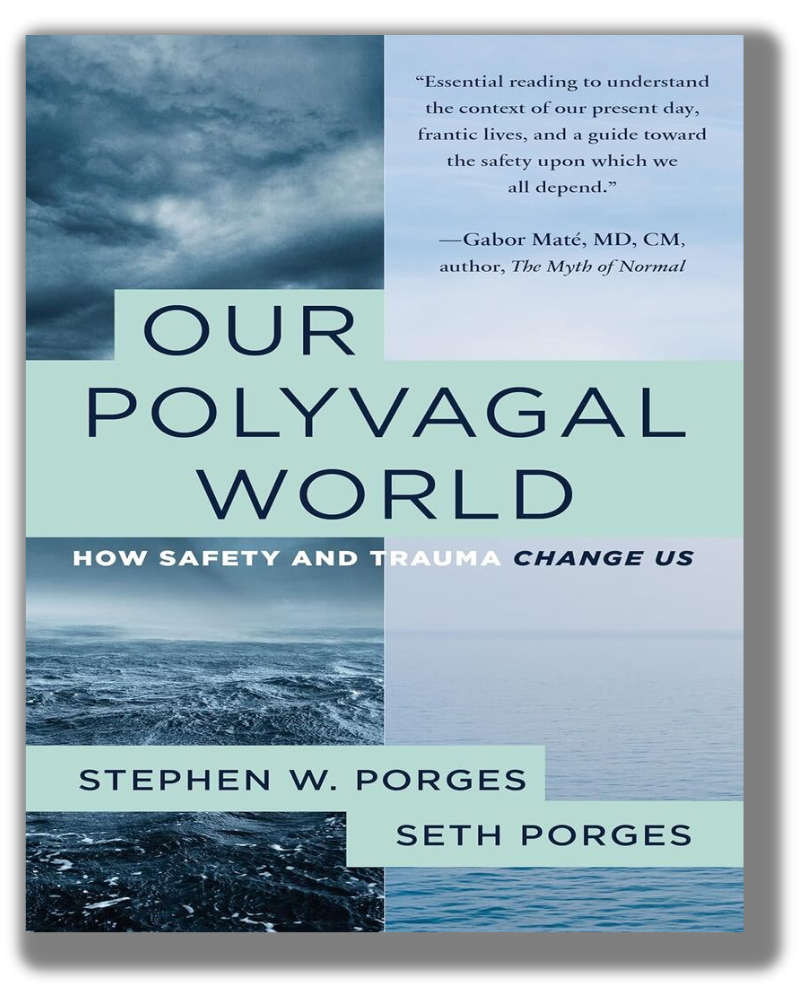
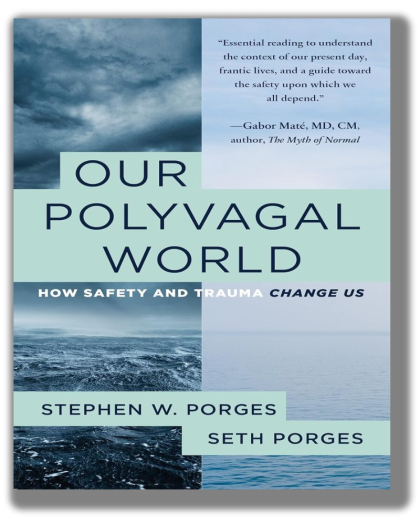
The creator of the Polyvagal Theory explains the principles in simple terms that are accessible to all.
Since Stephen Porges first proposed the Polyvagal Theory in 1994, its basic idea—that the level of safety we feel impacts our health and happiness—has radically shifted how researchers and clinicians approach trauma interventions and therapeutic interactions. Yet despite its wide acceptance, most of the writing on the topic has been obscured behind clinical texts and scientific jargon.
Our Polyvagal World definitively presents how Polyvagal Theory can be understandable to all and demonstrates how its practical principles are applicable to anyone looking to live their safest, best, healthiest, and happiest life. What emerges is a worldview filled with optimism and hope, and an understanding as to why our bodies sometimes act in ways our brains wish they didn’t.
Filled with actionable advice and real-world examples, this book will change the way you think about your brain, body, and ability to stay calm in a world that feels increasingly overwhelming and stressful.
Schizanthus Nerd (verified owner) –
I was tempted to post a glowing review as soon as I finished reading this book but held off. I wanted to see if time did anything to dull the glow. It’s been three weeks now and my feelings about this book are as shiny as ever.
Oftentimes when I find a book I expect to be life changing, I come away disappointed. When I do connect with a concept, I always plan on applying what I’ve learned to my life but then I move on to the next thing and my good intentions remain just that.
This book, though. It felt like entire chunks were written specifically with me in mind and the follow through? It actually happened!
I’ve been interested in learning about Polyvagal Theory but until now I’d never made it past the science speak. This is the first book I’ve found that doesn’t talk at you like a textbook but invites you to understand, using examples that are relatable. Examples like dogs and the Hulk.
So, what’s Polyvagal Theory all about?
“How safe we feel is crucial to our physical and mental health and happiness.”
Sounds obvious, right? How safe we feel can be different to how safe we are, though, and that’s a crucial distinction here.
By the end of this book, you’ll be well versed in the vagus nerve and why it matters. You’ll gain a better understanding of trauma: why we respond the way we do when traumatic events happen and why the impacts of such events make so much more sense than you’ve probably ever realised.
“The impact of trauma is not isolated to our brains, but stretches through our nervous system to virtually every part of our body, changing how our senses sense, how our organs operate, and just about every aspect of our physical and mental health.”
The first part of the book explains Polyvagal Theory in a way that made sense to me. I understood the sciencey bits and the examples that explained the sciencey bits, and I was able to apply it to specific parts of my life. I make more sense to me now! And the bonus is, so do other people!
To give you just one example, life experiences have made me particularly wary of breathing exercises. Many well meaning individuals have tried and failed to teach them to me over the years. It wasn’t until I learned from this book the best way to do them (because science) and how doing them helps (also science), that I was able to attempt them without my body panicking. I’m now someone who can use breathing exercises (the scientific way for scientifically proven benefits) to regulate myself. And it helps!
Along the way, I discovered why I’m hypersensitive to sound, particularly background noise. I’m currently also working on my own theory (which I haven’t found research on – yet) about whether the proximity of the trigeminal nerve to the vagus nerve may explain why I experience the pain pattern associated with trigeminal neuralgia after I spend a considerable amount of time in the red zone.
The second part of the book takes what you’ve learned and applies it to “circumstances and settings such as the pandemic, the workplace, schools, and prison.” While each of these chapters are helpful in their own right, by seeing how Polyvagal Theory applies to these, you are essentially given a road map to allow you to apply it elsewhere.
Then there’s the glossary, which amps up the science. If you don’t have a scientific background, you may not want to spend too much time here. I found I started to lose some confidence in what I had learned when I tried to decipher all of the science. Then I let it go. I didn’t need to be able to quote all of the right terminology to start making changes to my life.
This is a book I know I’ll keep coming back to. I expect I’ll need a refresher from time to time and as the circumstances of my life change, so will the parts of the book that speak to me.
I’ve already recommended this book to a bunch of people who work in the trauma field and I don’t think I’m going to be shutting up about it anytime soon.
Thank you so much to Edelweiss and Norton Professional Books, an imprint of W. W. Norton & Company, for the opportunity to read this book.
Jen (verified owner) –
This breaks down a complex — and incredibly important concept — in terms that are easily understood by every reader. An essential read for anyone hoping to understand trauma.
Brett Moses (verified owner) –
Although I’m only a few chapters in, it’s already clear: Our Polyvagal World is an essential read. A modern science masterpiece.
Melissa Unger (verified owner) –
I read this book yesterday in one sitting. I feel it is truly THE book for our era.
So important. It should be required reading for everyone!
I was already familiar with Polyvagal Theory, but this book puts clear words to much of my (and I’m sure many other people’s) felt experience, and it breaks open new paths to healing and does so in an easy to read, approachable way. I love how it explains not only Polyvagal Theory but also weaves in all the associated theories and examples… Highly readable and informative. And perhaps most importantly, it’s very human… it’s such a humanistic book – it’s not formulaic – it bridges scientific findings with a spiritual understanding, and much warmth. Great book… it’s such a valuable compendium of useful information presented in a very readable and digestible manner. Thank you to Stephen & Seth Porges for having made this book. I think it’s a genuine act of public service.
Kyliegirl (verified owner) –
Incredibly well-written and interesting book on this topic. The authors give great examples, outline their applications of this theory in a good amount of detail, and answer questions the reader is likely to have. I did feel like it ended too abruptly – a bit more “where to go from here” in the closing pages would have been helpful. But perhaps that’s the next book.
Thanks to the publisher and NetGalley for providing a copy of this book.
MK (verified owner) –
It definitely crystalized a lot of my thinking and understanding of the Polyvagal Theory and forced me to question and ponder some of my own preconceptions.
An accessible, insightful and essential read, especially in these times!
LaffingKat (verified owner) –
Assisted by his son, journalist Seth Porges, psychologist and neuroscientist Stephen Porges helps readers understand the importance of feeling safe and how to create a feeling of safety for ourselves and others. The first half of this book explains Dr. Porges’s polyvagal theory in very understandable terms. The second half of the book presents applications of the polyvagal theory in various circumstances, such as during a pandemic, at school or work, and in prisons. Although I have already read many books on the topic of trauma, this book helped me understand trauma in a new way and left me feeling hopeful that we can create a society and design environments that encourage a feeling of safety so that we all experience better health and more happiness.
This book offers a particularly good discussion of how the autonomic nervous system responds to feelings of safety and perceived threats, and how chronic stress or trauma therefore leads to widespread physical and mental health problems. I was especially impressed with the chapter on prisons, which makes it so clear why our current penal system causes more harm than good and needs to be reformed.
The back matter includes an epilogue that concisely summarizes the most important principles of the polyvagal theory, a detailed glossary, an explanation of common psychiatric diagnoses through the lens of the polyvagal theory, references, notes, and an index.
I think most people could benefit from reading this book, and I highly recommend it for anyone who wants to understand human behavior or is interested in creating a happier, healthier society.
I was provided an unproofed ARC through NetGalley that I volunteered to review.
paola (verified owner) –
I read this book and feel incredibly connected and related to it.
it is a surprisingly positive and unexpected familiar way to learn about how traumas have create a grid of mental processes, that do not help us.
I had not though about how to help myself on regards fear and what causes fear because external motives, and can analyze myself with tools that this book explains.
Susie B (verified owner) –
I absolutely love this book for better understanding the polyvagal theory and its applications. I had the privilege of meeting Dr porges last week and was happy to have read the book already. Excellent read great information to inform therapeutic interventions.
Batman the Horse (verified owner) –
I’ve read all of the major books on trauma, listened to the podcasts, watched the YouTube videos, and have spent countless hours in therapy. Suffice it to say, this isn’t my first time at the “self-help” rodeo.
It’s not that those things weren’t beneficial, I’ve just never connected with a book the way I did with Our Polyvagal World. It’s full of information that I hadn’t heard before and the theory, science, and biology behind the vagus nerve resonated with me as it makes more sense for my, uh, flavor of trauma.
Since reading this book I have been able to acknowledge, process, and benefit in ways that I hadn’t been able to before.
Mary (verified owner) –
This book hits a great sweet spot – well-written and backed by dense research. It’s accessible for anyone but the thought and rigor that has gone into understanding its ideas are as deep as it gets. I’ve already ordered copies as gifts for several folks who will benefit from its fascinating teachings.
There’s a glut of books out there on trauma and its impacts but do yourself a favor and focus on this one. It’s a refreshing, smart perspective on a topic that too often ends up in self-help fluff.
Phyllis Herzog (verified owner) –
I’ve heard about this bio theory over the past few years but never could fully understand it. Now, I do. Written for the layman with numerous examples. Fascinating to learn that mammalian evolution has several levels of “flight and fight” awareness and explains how it differs from person to person and how the vagal nerve system works. Recommended for social workers, therapists, teachers and others interested in human response and communication. I am, by the way, a distant cousin of the authors and have been aware of this area of research, but never really understood it. A worthwhile read for sure.
Jason (verified owner) –
So far I’m more than half way through the book. It is well written, though some political ideology comes through, it is easy to follow and understand what polyvagal theory is and how it plays a part in our lives. So far the only thing I have learned about helping to calm the nervous system is through some breathe work so maybe it is a long winded book to read to learn to just breathe in more deeply and exhale more slowly and long than your inhale. Over all a very interesting read.
Fibrillate (verified owner) –
I bought this after listening to the authors talk with the host on ‘the good life project’ podcast. It’s a great way to see if the book is for you so have a listen.